A brief history
A region between cultures
Located in south-western Germany, on the borders with France and Luxembourg, Saarland preserves traces of Roman life alongside a strong industrial heritage. Coal mining and steelmaking shaped the region’s development and the identity of its communities.
The twentieth century was marked by changes in administration and close ties with France. Today, the region celebrates both its historical heritage and its natural landscapes.
- 1920–1935The Saar territory was administered by the League of Nations. Following the 1935 plebiscite, it returned to Germany, which was then under Nazi rule.
- After 1945The region had a distinct status, with internal autonomy and economic ties to France.
- 1957 and 1959On 1 January 1957, Saarland became a state of the Federal Republic of Germany. Economic integration was completed in 1959.
Historical sources: Saarland Government — Regional history (PDF) and Portal Rheinische Geschichte.
Ideas for a day out
Six places to visit
01 · Nature
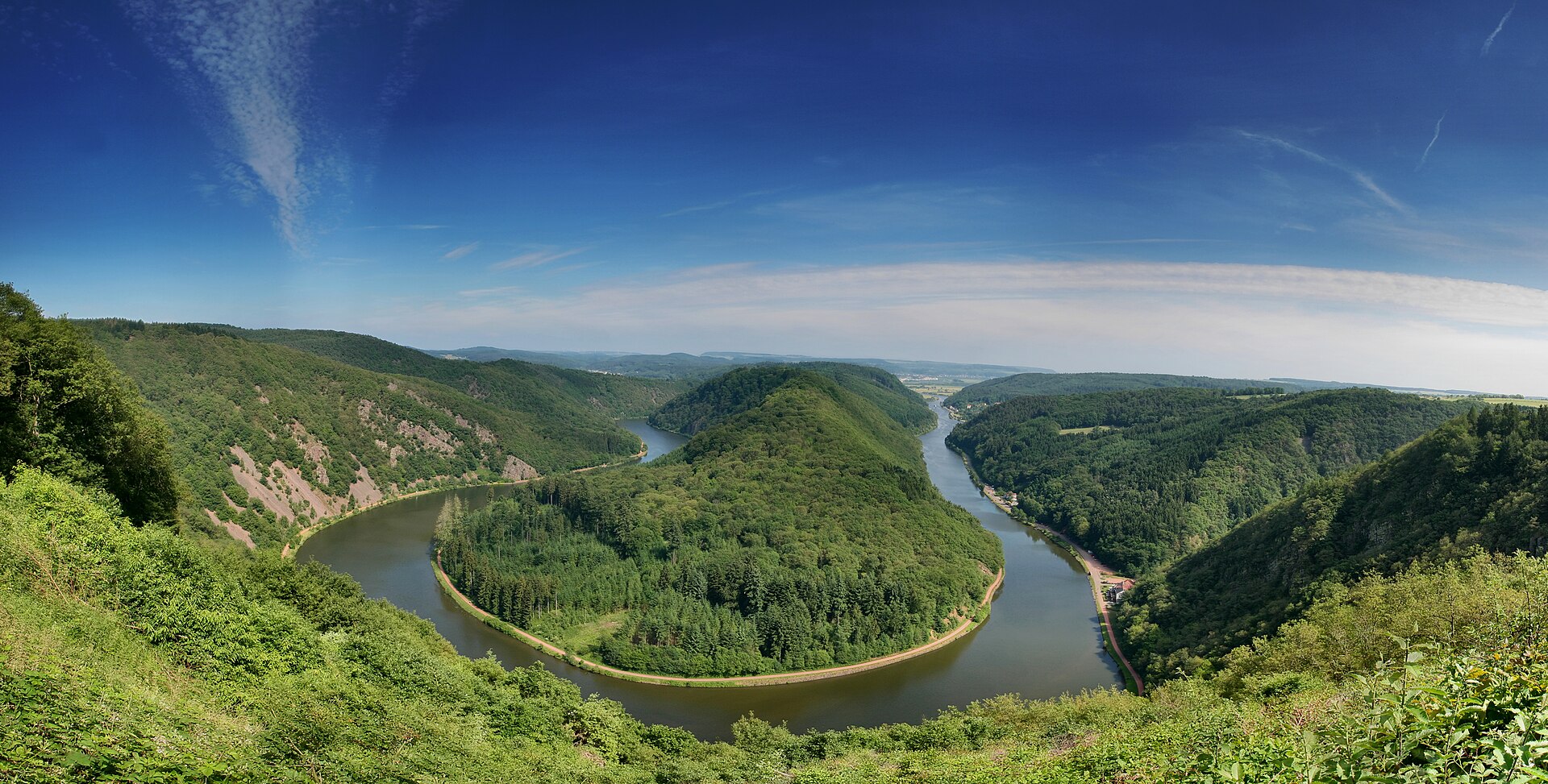
Saarschleife
Mettlach–Orscholz
Surrounded by wooded slopes, this bend in the River Saar is one of the region’s iconic landscapes. The Cloef viewpoint offers a panorama over the valley, while the Baumwipfelpfad provides a walk among the treetops.
02 · UNESCO heritage
Völklinger Hütte
Völklingen
This former ironworks preserves impressive industrial structures and tells the story of the industry that shaped Saarland. Listed as a UNESCO World Heritage Site in 1994, it also hosts art and cultural exhibitions.
03 · Architecture
Ludwigskirche
Saarbrücken · Ludwigsplatz
This Baroque Protestant church, designed by Friedrich Joachim Stengel, is an architectural landmark of the city. The square and surrounding buildings form an ensemble ideal for a walk through Saarbrücken’s history.
04 · City stroll
St. Johanner Markt
Saarbrücken · Old town
A lively square with pedestrian lanes, cafés and restaurants. The Baroque fountain, built to Stengel’s plans in 1759, recalls the history of the area. It is a good starting point for exploring the old town.
05 · Ancient history
Villa Borg
Perl–Borg
This archaeological park, featuring a reconstructed Roman villa, offers an insight into life on a rural estate in antiquity. Its buildings and grounds help visitors understand the region’s Roman heritage.
06 · Relax in nature
Bostalsee
Nohfelden · Sankt Wendeler Land
The lake and the path around it are ideal for walks and family outings. Swimming and water activities are available in season. Activities and access to leisure areas may vary with the season.
Before setting out, check the official websites for opening hours, tickets and access conditions. The map links will help you plan your route.